BStalker vs Spreadsheets: Why Google Sheets Fails at Pallet Tracking
The Spreadsheet Trap
Every pallet reseller starts with a spreadsheet. It makes sense at first — one pallet, a few items, a simple profit formula. But spreadsheets were built for static data, not for the reality of running a liquidation business where costs change daily and items flow in and out constantly.
The spreadsheet trap catches you around pallet number three. Suddenly you have 60+ items across multiple selling platforms, shipping costs that need splitting, overhead that should be prorated by days held, and no formula that handles all of it without breaking.
Where Spreadsheets Break Down
1. Cost Basis Allocation
When you buy a pallet for $400 with $200 in shipping, you need to allocate that $600 across every item. Some resellers split evenly (wrong — a $500 TV and a $10 phone case should not carry the same cost). Others split by retail value (better, but tedious to set up in a spreadsheet for every single lot).
BStalker handles cost basis allocation automatically. Import a manifest, and each item gets a proportional share of the pallet cost including shipping, buyer premium, and any other acquisition costs. No formulas to build, no manual splitting.
2. Overhead Proration
Your storage unit costs $200 a month. Your packing supplies run $50. Software subscriptions, internet, gas for pickups — call it $400 total monthly overhead. That is $13.33 per day across your business.
A spreadsheet cannot dynamically prorate that across pallets by how many days each one has been active. You would need a formula that tracks the acquisition date of every pallet, counts business days, divides overhead by active pallets, and recalculates every time you close out a lot. Most resellers give up and just ignore overhead entirely.
BStalker calculates your daily overhead burn rate and prorates it across active lots automatically. You see the real cost of holding inventory, not a fantasy number that ignores fixed costs.
3. Platform Fee Calculation
eBay charges ~13%. Mercari takes ~10%. Facebook Marketplace is free but you eat shipping. Poshmark takes 20%. Each platform has its own fee structure, and if you sell across multiple platforms (most resellers do), your spreadsheet needs a different fee formula per sale.
BStalker knows the fee structure of major platforms. Select where you sold, enter the price, and the net revenue calculates automatically. No fee lookup tables, no per-platform formulas.
4. Bundle Sales and Multi-Item Lots
You bundle three items from the same pallet and sell them as a lot. Now you need to split that sale revenue back across three items, each with its own cost basis, and mark all three as sold. In a spreadsheet, this is a nightmare of cross-references and manual adjustments.
BStalker handles bundle sales natively. Select the items, enter the bundle price, and each item gets the correct cost basis and revenue attribution. One action, accurate numbers.
5. Real-Time P&L
The whole point of tracking is to know whether you are making money. In a spreadsheet, getting an accurate P&L means manually updating every sale, every fee, every return, every new expense. Miss one entry and the whole picture is wrong.
BStalker generates a real-time profit and loss statement across your entire business. Filter by pallet, by date range, by platform. Every data point feeds automatically from your recorded sales and expenses.
What Spreadsheets Do Well
Spreadsheets are not worthless. They excel at one-time analysis: evaluating a manifest before bidding, modeling a hypothetical scenario, or building a quick comparison. If you flip one pallet per month as a hobby, a spreadsheet is probably fine.
The breaking point is scale. Once you are running three or more pallets concurrently, selling across multiple platforms, and trying to understand which categories and suppliers deliver the best ROI, a spreadsheet creates more work than it saves.
The Real Cost of Spreadsheet Errors
The danger is not that spreadsheets are slow. The danger is that they give you wrong numbers that feel right. A broken formula does not throw an error — it just quietly shows you a profit margin that does not exist. You keep buying pallets that look profitable on the spreadsheet but actually lose money after all costs.
Most resellers who switch to dedicated tracking tools discover they were overestimating their margins by 15–30%. That is the difference between a business that grows and one that slowly bleeds cash without knowing why.
Make the Switch
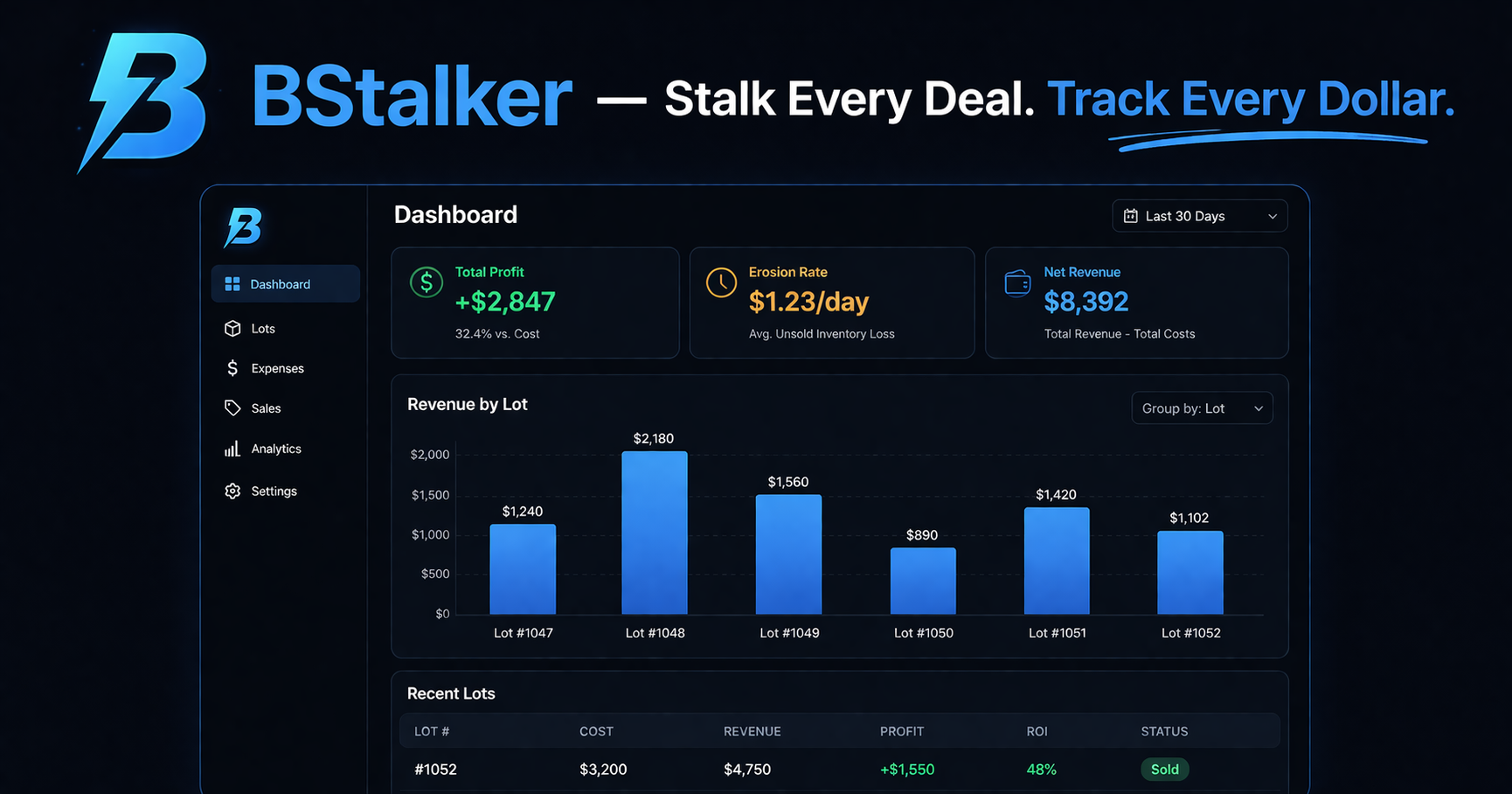
BStalker was built by a pallet reseller who hit the spreadsheet wall and decided to solve it. It handles cost basis allocation, overhead proration, platform fees, bundle sales, erosion tracking, and real-time P&L — all the things that make spreadsheets collapse under the weight of a real liquidation business.
Start your free trial and see what your pallets are actually making you.
Already using a spreadsheet? Try the free pallet profit calculator to see how your numbers compare.
Stop guessing. Start tracking.
BStalker automates pallet profit tracking so you know your real margins.
Start Your Free Trial